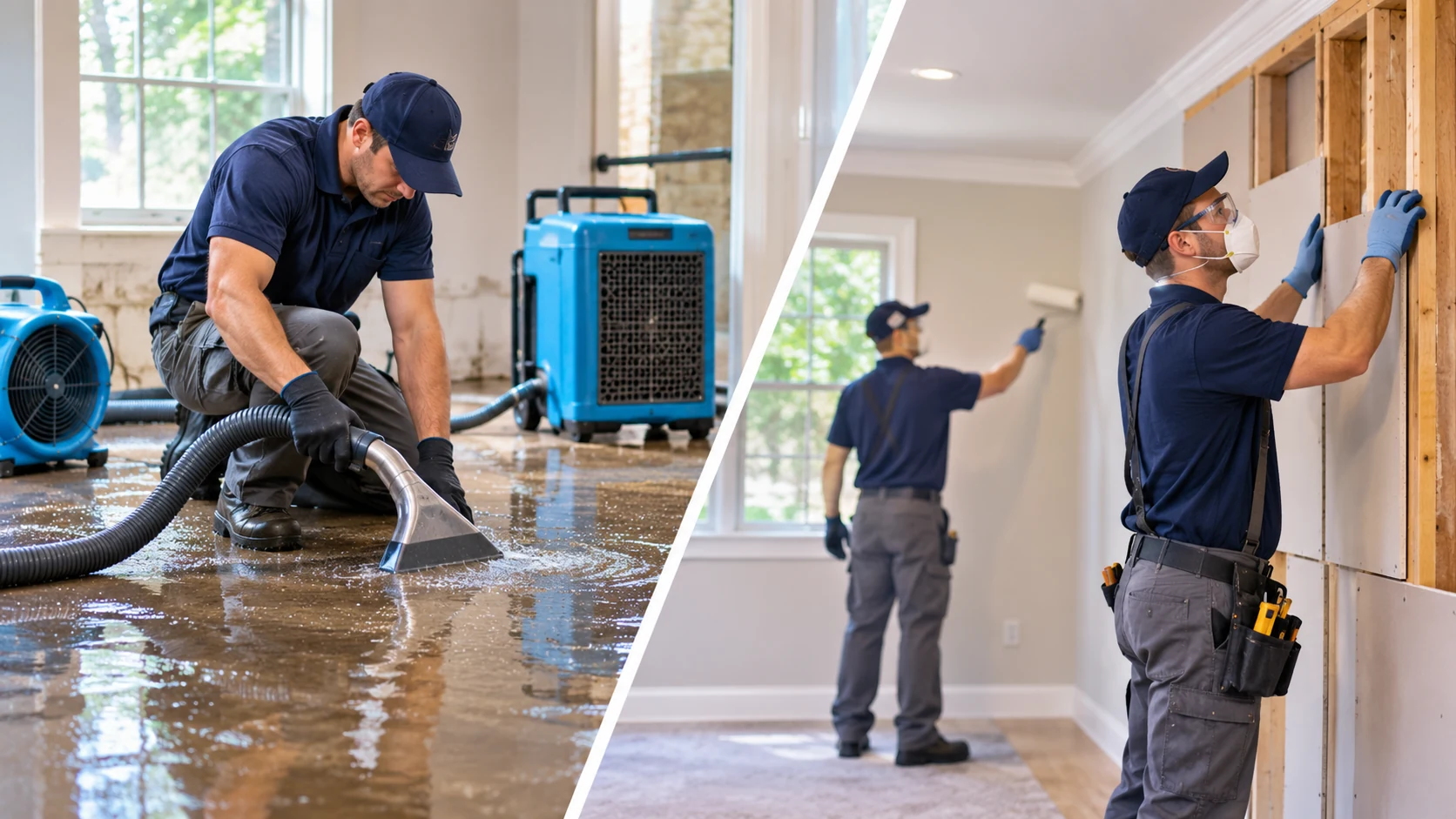
Water mitigation is the emergency work that stops water damage from getting worse. Water damage restoration is the repair work that puts the property back together afterward. Mitigation removes the water and dries the structure in the first hours and days. Restoration replaces the drywall, flooring, insulation, and finishes that could not be saved.
The two are stages of one recovery, not competing services. Most losses of any real size need both, in that order.
The distinction shapes what equipment arrives, how long each phase takes, and how the work is handled on an insurance claim. Here is what each phase involves and how to tell which one your situation calls for.
Water mitigation vs. restoration at a glance
| Water mitigation | Water damage restoration | |
|---|---|---|
| Goal | Stop the damage from spreading | Return the property to pre-loss condition |
| Timing | Immediately, within hours | After drying is verified complete |
| Main work | Extraction, containment, structural drying | Repair, replacement, rebuilding, refinishing |
| Typical duration | Days — drying commonly runs 3 to 5 days | Days to weeks, depending on the damage |
| Equipment | Extractors, air movers, dehumidifiers, moisture meters | Construction tools and materials |
| Measure of success | Materials reach documented dry readings | The space looks and functions as it did before |
What is water mitigation?
Water mitigation is the emergency phase of water damage recovery. Its single purpose is to limit the loss: stop the source, remove the water, contain the affected area, and dry the structure before moisture spreads further or mold takes hold.
Mitigation does not repair anything. It protects what is not yet damaged.
The phase is urgent because water damage grows on its own. Water wicks upward through drywall, travels sideways under flooring, and soaks into insulation, subfloors, and framing where a towel cannot reach. The U.S. Environmental Protection Agency advises drying wet building materials within 24 to 48 hours to prevent mold growth. In Houston's humidity, hitting that window without professional drying equipment is harder than most property owners expect.
Emergency water mitigation is what a restoration company means when it talks about responding fast. Our water mitigation service in Houston covers this stage.
What is water damage restoration?
Water damage restoration is the repair phase. It begins after the structure is dry and returns the property to the condition it was in before the water event.
Restoration is construction work: removing materials that could not be saved, replacing drywall and insulation, repairing or refinishing flooring, reinstalling trim and cabinetry, repainting, and handling any structural repairs the water caused. Where damage went beyond the surface, this is the longest phase.
The term is also used loosely, which is where most of the confusion starts. Many companies, including this one, use "water damage restoration" as the name for the whole service, mitigation included — so water damage restoration in Houston means the full recovery from the first call to the final repair. On an adjuster's scope of work, the same word usually means the repair phase alone. If you are reading a claim document, it is worth asking which meaning is intended.
What is the water mitigation process?
Mitigation follows a fairly consistent sequence, because each step makes the next one possible.
- Stop the source. No drying works while water is still entering. That may mean closing the main shut-off valve, capping a supply line, or tarping a roof.
- Assess and document. A technician maps how far the water traveled using moisture meters and thermal imaging, since water almost always spreads further than the visible wet area. The water is also classified as clean, gray, or black, which decides what can be saved.
- Extract the standing water. Truck-mounted or portable units pull water out of the area and out of carpet, padding, and other absorbent materials. Removing bulk water is far faster than evaporating it.
- Contain the area. Plastic barriers seal the wet zone off, so humid air does not carry moisture into dry rooms and the equipment works on a smaller volume of air.
- Remove unsalvageable materials. Soaked carpet padding, saturated insulation, and drywall that cannot be dried in place come out now rather than later, because they hold water that slows the whole job.
- Dry the structure. Air movers speed evaporation across wet surfaces while dehumidifiers pull that moisture out of the air. Structural drying and dehumidification run continuously, typically three to five days.
- Monitor until dry. Technicians take readings daily and move equipment as conditions change. Drying is finished when moisture readings return to normal for the building, not when a set number of days has passed.
Mitigation ends at a measurable point: the structure is dry and stable. That is the handoff.
What is the water restoration process?
Restoration picks up where drying ends and works in roughly this order.
- Confirm the structure is dry. A careful contractor will not close a wall that still reads wet. Moisture documentation from the mitigation phase is the gate.
- Clean and sanitize. Affected surfaces are cleaned and, where the water was unsanitary, treated with antimicrobial products. Salvageable contents are cleaned and deodorized.
- Rebuild the structure. Drywall, insulation, subfloor sections, and framing repairs go back in.
- Restore the finishes. Flooring, trim, baseboards, cabinetry, paint, and fixtures.
- Final walkthrough. The space is checked against how it looked and worked before.
Water damage repair is the hands-on part of this phase, covering drywall, ceilings, walls, flooring, and baseboards. How much is needed varies enormously. A bathroom supply line caught in twenty minutes might need a repainted section of wall. A dishwasher that leaked behind a cabinet for weeks can mean new flooring across an open-plan kitchen.
What are the key differences between mitigation and restoration?
Three differences explain most of the confusion.
Purpose. Mitigation prevents damage; restoration repairs it. Mitigation is a drying problem, run with meters and dehumidifiers and judged by readings. Restoration is a construction problem, run with materials and trades and judged by the finished result.
Timing. Mitigation is time-critical and should start the same day. Restoration is not urgent in the same way, and starting it early is actively harmful, because finishes installed over damp framing trap moisture where it cannot evaporate.
What the work leaves behind. A property at the end of mitigation is dry but often unfinished: missing baseboards, a section of drywall cut away, flooring lifted. That is a normal midpoint, not an abandoned job. Restoration is what closes it out.
Do you need mitigation, restoration, or both?
Most water losses need both, but not all of them. Use this as a rough guide.
| Situation | What it usually calls for |
|---|---|
| Clean-water spill caught within an hour, surface only | Mitigation only — often drying alone |
| Supply line leak found the same day | Mitigation, then minor restoration |
| Leak that ran unnoticed for days or weeks | Mitigation plus substantial restoration |
| Sewage backup or outside floodwater | Mitigation with cleanup and sanitizing, then restoration |
| Visible mold or materials already deteriorating | Assessment first — the scope is likely wider than it appears |
A useful rule: if the water only sat on a hard, non-porous surface and was removed quickly, you are probably in mitigation-only territory. Once water has been absorbed by drywall, carpet padding, insulation, or subfloor, repairs usually follow the drying.
The water category matters as much as the volume. Clean water from a supply line is the most salvageable. Gray water from a washing machine or dishwasher carries contaminants. Black water from a sewer line or outside flooding is a biohazard, and porous materials it touched are usually removed rather than dried. Our guide to the three water damage categories covers that call, and restore versus replace works through it material by material.
How do mitigation and restoration appear on an insurance claim?
Property insurance policies generally treat the two phases as separate pieces of work. Most ask the property owner to take reasonable steps to prevent further damage after a loss, often called the duty to mitigate. In practice that means stopping the water and getting drying started promptly rather than waiting for an adjuster to arrive. Mitigation and repairs are also commonly scoped and approved separately, since mitigation has to begin before anyone can see the full extent of the damage.
Documentation connects the two. Photographs taken before anything is moved, moisture readings from the drying phase, and a record of the materials removed all support the repair scope later. Policy terms vary, so check yours or ask your adjuster. Our article on what to document for a water damage insurance claim covers the records worth keeping.
What mistakes do property owners make with this?
Four errors come up repeatedly, and each one costs time later.
- Starting repairs before drying is verified. New drywall over wet framing seals moisture inside the wall. It resurfaces as staining, odor, or mold within weeks, and the work has to be torn out and redone.
- Treating mitigation as optional. Waiting a few days to see whether things dry on their own turns a drying job into a demolition job. The damage curve is steepest in the first 48 hours.
- Relying on household fans and a box-store dehumidifier. These move surface air. They do not reach water inside a wall cavity, under a floating floor, or in a subfloor, and that trapped moisture causes the problems nobody saw coming.
- Measuring dryness by touch. A floor can feel dry while the material underneath is saturated. Dryness is a documented meter reading, which is what water damage inspection and moisture detection confirms.
When should you call a professional?
Call a restoration company as soon as water has reached porous building materials: drywall, carpet and padding, insulation, subfloor, or cabinetry. That is the point where the drying problem stops being something fans can solve.
Also call if any of the following apply, regardless of how small the area looks:
- The water came from a sewer line, a toilet overflow beyond the bowl, or outside flooding.
- The water ran for more than a few hours, or you do not know when it started.
- Water came through a ceiling from the floor above.
- You can smell a musty odor, or materials have already started to warp, buckle, or stain.
- The affected area includes a wall cavity, a subfloor, or anything you cannot see into.
For a small clean-water spill on tile or sealed concrete, caught immediately and wiped up, professional water extraction is more than you need. Watch the baseboards and the edges of the room for the next week anyway, since that is where hidden moisture shows first.
Timing is usually the deciding factor. Mitigation gets harder to do well with every hour the water sits, while restoration can wait until the structure is dry. When in doubt, get the drying started — early drying is also the most effective mold prevention after water damage there is.
The short version
Water mitigation and water damage restoration answer two different questions. Mitigation asks how to stop this from getting worse, and answers with extraction, containment, and drying in the first hours and days. Restoration asks how to put this back, and answers with repairs once the moisture is gone.
Neither substitutes for the other, and the order is fixed. Done properly, mitigation keeps the restoration scope as small as possible — which is the whole reason the first phase moves so fast.
For how the full recovery timeline usually unfolds, see how long water damage restoration takes.
Frequently asked questions
What is the difference between water mitigation and water damage restoration?
Does water mitigation come before restoration?
Do I need both water mitigation and restoration?
How long does water mitigation take compared to restoration?
Is water mitigation the same as water damage cleanup?
Why is water mitigation so urgent?
Can I handle water mitigation myself?
Not sure whether you need mitigation, repairs, or both?
Tell us what happened and what you are seeing. We'll walk through where your situation sits and what should happen first.