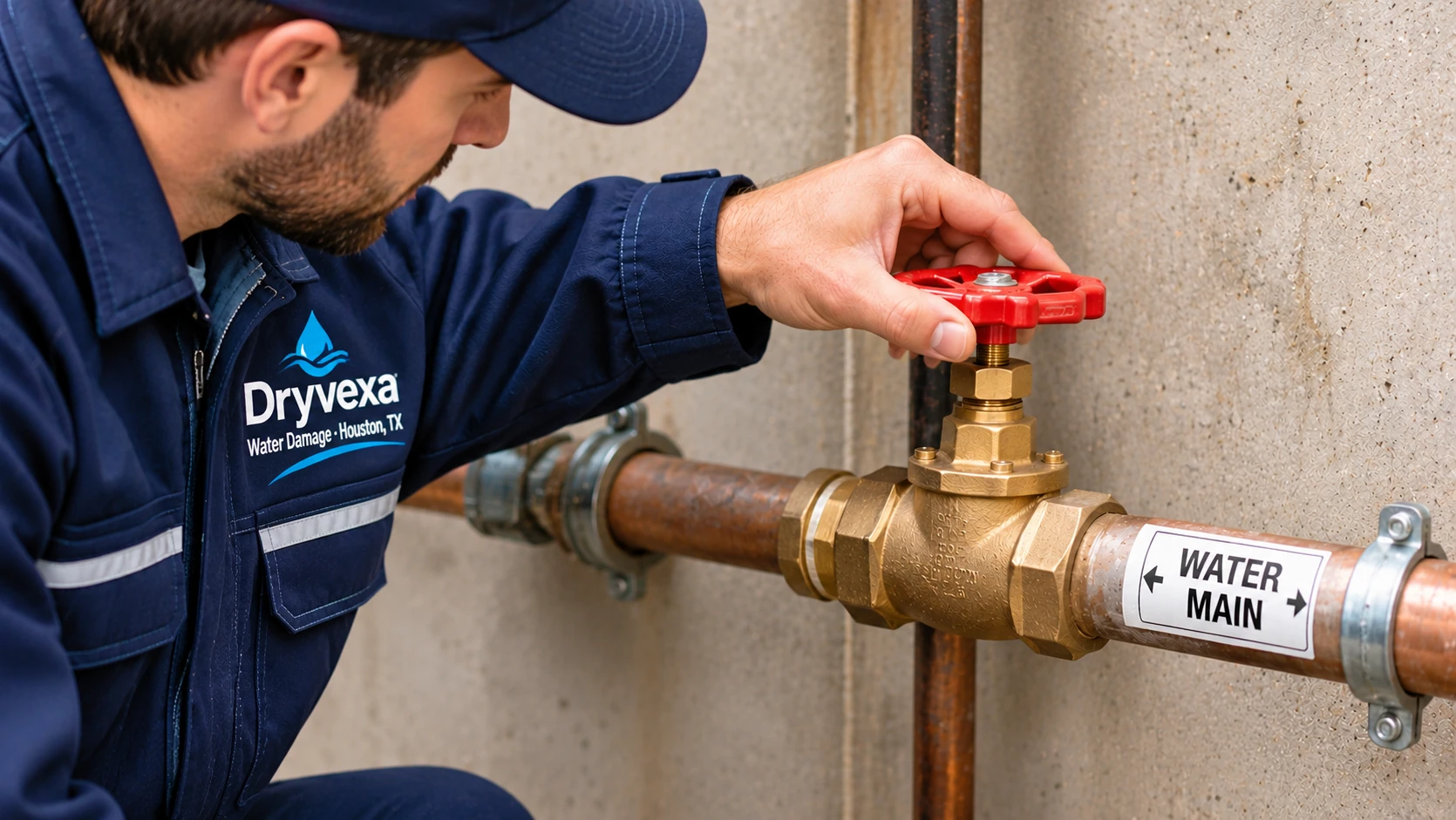
To shut off your water main, find the main shut-off valve where the water line enters your home and close it. Turn a round wheel handle clockwise until it stops, or turn a straight lever handle a quarter turn so it sits crosswise to the pipe. Then open a faucet at the lowest point in the house to drain the water still sitting in the pipes.
That is the whole procedure, and it takes about thirty seconds once you know where the valve is. The problem is that most people go looking for the valve for the first time while water is spreading across the floor.
Find yours today, while nothing is wrong. Below is where to look, how each valve type works, what to do when one will not turn, and when the job belongs to a professional.
Where is the main water shut-off valve?
The main shut-off valve is almost always where the supply line enters the building, on the side of the house closest to the street. Houston homes are mostly built on concrete slabs and rarely have basements, so the usual hiding places in colder parts of the country do not apply here.
Check these four spots, in this order:
| Where to look | What you are looking for |
|---|---|
| Exterior wall near the front of the house | A valve on a vertical pipe, often near an outdoor faucet or hose bib |
| Garage or utility closet | A valve on the supply line, often close to the water heater |
| Meter box at the curb or in the front yard | A rectangular concrete or plastic lid at ground level, usually marked "water" |
| Access panel or crawl space | In some older homes, behind a small removable panel |
A few things are worth knowing before you go looking.
Most homes have two valves: one at the house and one in the meter box. The house valve is the one you want in an emergency, because it is yours to operate and usually easier to reach.
If yours sits next to the water heater, note the heater's own shut-off valve while you are there. A tank that fails in a garage or utility closet is a common enough problem that water heater leak cleanup is its own job, and that second valve lets you stop it without cutting water to the whole house.
And the valve is often buried behind storage boxes, a shelf, or a shrub. Clear the space now so you are not moving a lawnmower in the dark later. Tag it with a bright zip tie, then show everyone in the house where it is.
How do you turn off the water main?
Close the valve, then drain the pressure out of the lines. Here is the full sequence.
- Stay safe first. If water has reached outlets, appliances, or a light fixture, do not wade in. Cut power to those circuits at the breaker panel, and only if you can reach the panel without standing in water.
- Identify the handle. A round wheel means a gate valve. A straight lever means a ball valve. They close differently.
- Close the valve. Turn a wheel handle clockwise until it stops, which may take several full rotations. Turn a lever handle a quarter turn until it is perpendicular to the pipe.
- Open the lowest faucet in the house. A ground-floor tub, a laundry sink, or an outdoor faucet works. This drains the water left in the pipes so it stops feeding the leak.
- Open an upstairs faucet too, if you have one. Letting air into the top of the system helps the lines empty faster.
- Protect the water heater. With the supply off, a tank heater can keep heating an emptying tank. Switch a gas heater to its vacation or pilot setting, and turn off power to an electric heater at the breaker.
- Confirm the water stopped. Watch the leak for a minute. If it slows but does not stop immediately, water is still draining out of the lines, which is normal and should taper off.
Write down the time you shut the water off. It is useful later for an insurance claim and for whoever handles the cleanup.
What are the different types of shut-off valves?
Four valve types cover almost every home. Knowing which one you have tells you how it closes and how much trouble it is likely to give you.
| Valve type | How to recognize it | How to close it |
|---|---|---|
| Ball valve | Straight lever handle | Quarter turn; closed when the lever crosses the pipe |
| Gate valve | Round wheel handle | Turn clockwise, often several full rotations |
| Globe or stop-and-waste valve | Round handle, bulging valve body | Turn clockwise; common on older supply lines |
| Curb stop | Inside the meter box, often a flat tab or nut | Needs a curb key; usually utility equipment |
Ball valves are the ones you want. They close completely in a single motion, and they tend to keep working even after sitting untouched for years.
Gate valves are the ones that fail. A brass stem lifts a wedge inside the valve body, and after years in the open position, mineral deposits bind it in place. Gate valves are why so many homeowners discover their shut-off is useless at the worst possible moment. If your home has one, a plumber can swap it for a ball valve during ordinary, non-emergency work. That is a far better time to find out than during a leak.
What if the shut-off valve is stuck?
Do not force a stuck valve. On an old gate valve, the stem can snap or the wedge can break loose inside the pipe, and a slow leak becomes an open line you now have no way to close.
Work through these in order:
- Use both hands and steady pressure. Slow and firm beats sudden and hard.
- Try penetrating oil. Spray where the stem meets the valve body, wait about fifteen minutes, then try small back-and-forth movements rather than one big push.
- Skip the pipe wrench. The extra leverage on a corroded valve is exactly what breaks the stem.
- Shut off a smaller section instead. Most toilets, sinks, and water heaters have their own shut-off valve. If the leak is at one fixture, closing that valve solves the problem without touching the main.
- Call for help. A licensed plumber can close or replace the valve, and your water provider can shut off service at the meter.
Once the emergency is over, replace the valve. A shut-off that does not shut off is not a shut-off.
Can you shut off the water at the meter?
Sometimes, but treat the meter box as a last resort rather than a first move. The valve inside the box is typically part of the water system rather than your plumbing, and it usually requires a curb key, a long T-shaped tool, rather than a handle you can grip.
Two cautions apply almost everywhere. Water providers commonly ask customers not to operate the meter valve, and you can be billed for damage to the meter or the valve if something breaks.
In Houston, responsibility is split at the meter: the city generally maintains the line from the street to the meter, and everything from the meter into the home belongs to the property owner. Water service problems and leaks are reported through the city's 311 service, which can also determine which side of the meter a problem is on. If your own shut-off has failed and water is running, call your provider instead of prying into the box with a screwdriver.
When should you shut off the water main?
Shut off the main any time water is escaping and you cannot stop it at the fixture. The common situations:
- A burst or leaking supply pipe, including one that froze and split.
- A failed washing machine or dishwasher hose, when the appliance valve is unreachable or stuck.
- A water heater leaking from the tank itself, not just from the fittings.
- An overflowing toilet whose own shut-off valve will not close.
- Water coming through a ceiling from a floor above.
- Before plumbing work, such as replacing a faucet or a toilet.
- Before a hard freeze or a long trip, as a precaution.
Speed matters because a failed supply line runs continuously, and the damage scales with the minutes. Water wicks up drywall, soaks into the subfloor, and spreads sideways under flooring, which happens readily on a slab. The EPA advises drying water-damaged areas and items within 24 to 48 hours to prevent mold growth, and Houston's humidity makes that window harder to hit than most people expect.
What safety rules apply before you touch the valve?
Water combined with electricity is the real hazard here, not the plumbing. Read these before you go near the valve.
When should you call a professional?
Call a plumber for the pipe itself: a stuck or broken valve, a split supply line, a failed water heater, or a leak you cannot locate.
Call a water damage restoration company for what the water left behind. These are two different jobs, and the second is the one homeowners tend to underestimate. By the time a floor looks dry, water has usually moved into the subfloor, the wall cavity, the insulation, and the framing, where a towel cannot reach it. Restoration crews use moisture meters and thermal imaging to map how far the water traveled, then extract and dry the structure to a documented moisture level.
If water has reached flooring, drywall, or cabinets, that is the point to make the call. Our water damage restoration in Houston service covers extraction through structural drying, with focused help for burst pipes, plumbing leaks, and appliance failures.
What should you do after the water is off?
Shutting off the main stops the problem from growing. It does not undo what already happened.
- Photograph everything before you move or discard anything. Document the source, the standing water, and every affected room. This supports an insurance claim.
- Remove what water you safely can, and lift furniture and electronics out of the wet area or set them on blocks.
- Get air moving, but do not count on fans alone. Drying wet building materials takes dehumidification, not just airflow.
- Check what you cannot see. Water travels. Our guide to signs of hidden water damage covers what to watch for in the days that follow.
For an hour-by-hour walkthrough of the first day after a pipe fails, see what to do after a burst pipe. If a freeze caused it, preventing frozen pipes in Houston covers keeping it from happening again.
Frequently asked questions
How do I shut off my water main?
Where is the main water shut-off valve in a house?
Which way do you turn a water shut-off valve to close it?
What do I do if my water shut-off valve is stuck?
Can I turn off the water at the meter myself?
Should I shut off the water main when I go on vacation?
Water already in your floors or walls?
Once the water is off, call and we'll talk through what you're seeing and what the next step should be.