Choose a water damage restoration company by verifying four things before anyone starts work: IICRC certification, proof of liability and workers' compensation insurance, a Texas mold remediation license if mold work may be involved, and a commitment to document drying with daily moisture readings. Then get the scope of work in writing before equipment goes in the door.
That is the short version. The hard part is that you are usually choosing under pressure. Water is spreading, the carpet is soaked, and someone is already on the phone telling you they can be there in twenty minutes. This guide covers what actually separates a competent Houston restoration company from an expensive mistake, and how to check it fast.
What should you verify before hiring a restoration company?
Work through these in order. The first three take a few minutes each and eliminate most bad options.
| What to verify | What to ask for | Why it matters |
|---|---|---|
| IICRC certification | Which technicians on your crew are certified | Shows the crew is trained to a recognized industry standard |
| Insurance | Certificate of liability and workers' comp | Protects you if a worker is injured or your property is damaged |
| Texas mold license | TDLR mold remediation contractor license | Required by Texas law for most mold remediation work |
| Drying documentation | Daily moisture readings and a drying log | Proves your home is actually dry, not just dry-looking |
| Scope of work | Written scope before work begins | Prevents surprises about what is and is not included |
Why does IICRC certification matter?
IICRC certification is the clearest signal that a restoration crew is trained to a recognized standard. The Institute of Inspection, Cleaning and Restoration Certification is an ANSI-accredited standards developing organization. It publishes ANSI/IICRC S500, the Standard for Professional Water Damage Restoration, and it certifies individual technicians, including the Water Damage Restoration Technician (WRT) credential.
The distinction worth knowing: S500 is a standard, not a license, and it is voluntary. No one is legally required to follow it. That is exactly why it works as a filter. A company that references S500 and staffs certified technicians has chosen to work to a published standard of care.
Ask the question precisely. "Are you IICRC certified?" gets a yes from almost everyone. "Which technicians on my job are certified, and in what?" is the question that actually tells you something.
Does the company need a Texas mold license?
Yes, if mold remediation may be involved, and in Houston it often is. The Texas Department of Licensing and Regulation (TDLR) licenses mold assessors and mold remediation contractors. Under the Texas Mold Assessors and Remediators law, remediation of 25 contiguous square feet or more of visible mold generally requires a licensed mold remediation contractor, and a remediation notification must be filed with TDLR before that work begins.
There is a second rule most homeowners never hear about, and it protects you directly: a license holder may not perform both the mold assessment and the mold remediation on the same project. The company that tells you how much mold you have is not allowed to be the company that gets paid to remove it. If one contractor offers to inspect for mold and then remediate it on the same job, that is not a package deal. It is a conflict Texas law was written to prevent.
This matters more in Houston than in a dry climate. Mold can begin growing on damp materials within 24 to 48 hours, and our humidity keeps materials wet longer. A water loss here turns into a mold question faster than most homeowners expect, so treat mold prevention after water damage as part of the hiring decision rather than a problem for later.
How fast can they actually be on site?
Response time is a real selection criterion, not a marketing line, because the clock is the thing you are fighting. Every hour water sits, it wicks further into drywall, subfloor, and insulation. That means longer drying, more demolition, and more that has to be rebuilt.
Ask two specific questions:
- How soon can a technician be physically on site? Not "we're available any time," but an actual arrival window.
- Will drying equipment be set today, or only after an inspection visit? Some companies inspect on day one and return with equipment on day two. In a humid climate, a lost day is not a small thing.
After a hurricane or a major Houston storm, honest answers get longer for everyone. A company that promises you the same arrival time during a region-wide flood event as on a normal Tuesday is either very large or not being straight with you.
What equipment and documentation should they provide?
A professional job is measurable. Ask what the company uses and what it hands you.
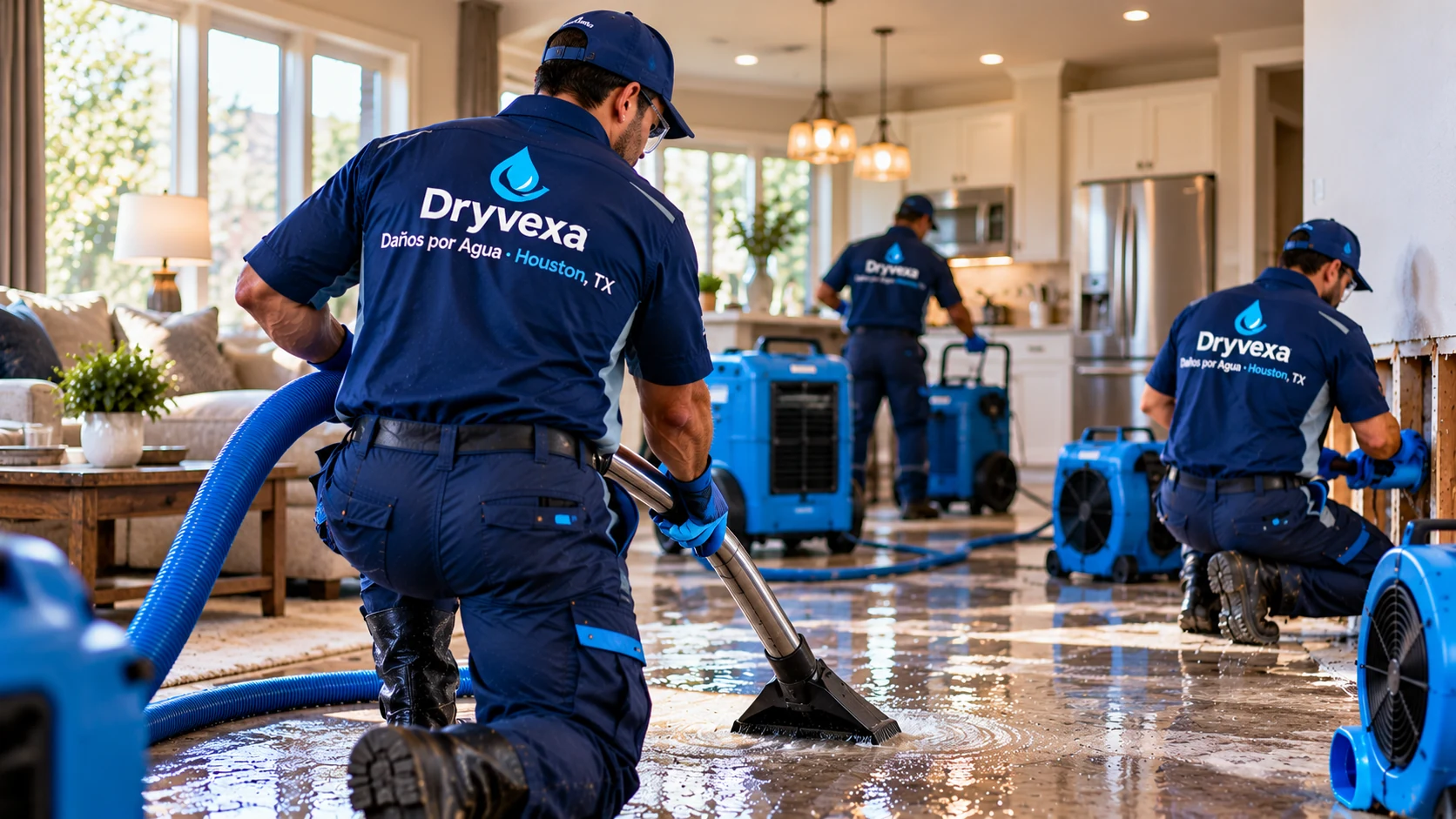
- Moisture meters and thermal imaging to find water inside walls, ceilings, and under flooring, not just what is visible. This is the core of a real water damage inspection.
- Air movers and dehumidifiers sized and placed for the affected area, running continuously.
- Daily moisture readings recorded in a drying log, so drying ends when materials hit a documented dry standard rather than when the calendar says so.
- Photos before, during, and after the work.
That documentation is also what supports an insurance claim. If a company cannot explain how it will prove your home is dry, you have no way to know whether it is.
Can they handle your water category and the repairs after?
Not all water is the same, and not all companies handle all of it. Restoration professionals classify water as clean (Category 1), gray (Category 2), or black (Category 3). Black water, which covers sewage backups, storm flooding, and anything carrying contamination, requires containment, sanitizing, and disposal of porous materials. It is not a job for a crew set up only for clean-water leaks.
Then ask what happens after drying. Mitigation (water removal and drying) and reconstruction (drywall, flooring, paint) are different trades. Some companies do both; some stop at dry. Neither is wrong, but you want to know before you are standing in a dry room with open walls, looking for a second contractor.
What are the red flags?
Some of these are judgment calls. Two of them are Texas law.
- An offer to waive, cover, or "take care of" your insurance deductible. The Texas Department of Insurance states this is illegal, including the common workaround of inflating the repair estimate so the insurer's payment absorbs it. Walk away.
- A contractor who wants to handle your claim for you. Negotiating your claim is the role of a licensed public insurance adjuster, and Texas restricts contractors from acting as adjusters on property they are also working on. A restoration company can document damage and talk to your adjuster, but it should not be your adjuster.
- No written scope before work starts. Verbal plans and signed blank authorization forms are how disputes begin.
- Pressure to sign immediately, especially door-to-door after a storm.
- No verifiable local address or license information, and reluctance to produce an insurance certificate.
- A promise that everything can be dried and saved. Honest companies tell you what has to go. Whether a material can be saved depends on what it is and how long it stayed wet.
Does it matter that the company is local to Houston?
It matters for reasons that are practical rather than sentimental.
Travel time is part of the service. With mold growth possible inside 24 to 48 hours, a crew based across the metro is a different proposition from one dispatched from out of region after a storm.
Houston conditions change the work. High outdoor humidity slows evaporation, so dehumidification carries more of the load and runs longer. Homes built on concrete slabs, which are common here, spread water sideways across the slab and under flooring rather than draining away. Hidden moisture becomes the norm rather than the exception.
Flooding is a separate insurance question. Standard homeowners policies generally do not cover flood damage. Flood coverage is a separate policy, usually through the National Flood Insurance Program. FEMA reports that about one-third of NFIP flood claims from 2013 to 2023 came from outside high-risk flood areas, which is worth knowing in a region where that assumption costs people money. A company that works storm and flood losses in Houston regularly will be familiar with how these claims are handled.
What should you ask before you hire?
Keep this list by the phone. Six answers will tell you most of what you need to know.
- Which technicians on my job are IICRC certified, and in what?
- Are you licensed by TDLR for mold remediation in Texas?
- How soon can a technician be on site, and will drying equipment be set today?
- What moisture detection equipment will you use, and will I get daily readings?
- Does your scope include repairs after drying, or mitigation only?
- Can you send a certificate of liability and workers' compensation insurance?
If answers are vague, keep calling. The company that answers these clearly, before asking you to sign anything, is usually the one you want.
If water is spreading in your home right now, do not wait until you have finished vetting anyone. Shut off the water source if you safely can, and get professional water damage restoration in Houston moving. You can ask every question above while a crew is on the way.
Frequently asked questions
How do I choose a water damage restoration company in Houston?
What certification should a water damage restoration company have?
Does a water damage company in Texas need a mold license?
Is it legal for a restoration contractor to waive my insurance deductible?
Should I hire a local Houston restoration company or a national one?
What questions should I ask before hiring a restoration company?
Have questions before you hire anyone?
Call and ask us the same questions this article says to ask. We'll tell you what your situation needs and what to expect, with no pressure.